Need to know old boy. Principle of Minimum Access for LLMs
/
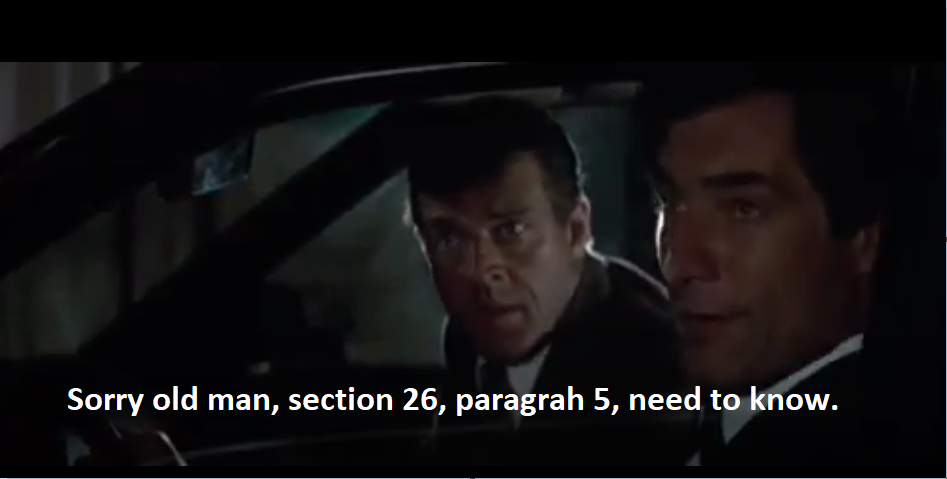
Principle of Minimum Access for LLMs can be described by Timothy Dalton as James Bond in “The Living daylights”. Bond says the phrase “Sorry old boy, section 26, paragraph 5, need to know.” to a fellow agent and drives off escorting a VIP – very important target.
Behind the scene is a practical idea that fits modern AI systems very well: an LLM or agent (as in the movie) should only be given the minimum access it needs to do its job. Not more, not less. Bare minimum. Of course Mythos probably could jailbreak anyway but still… controll is the best form of trust ?
This is not just a security preference we should choose. It is a design principle. The more access you give an agent, the more damage it can do if something goes side ways. That is true for prompts, tools, API keys, databases, files, and external services. Remember when amazon failed cause some AI decided to rewrite part of the achitectural stack ? 🙂 Good architecture assumes that.
An LLM is not a “trusted” human operator. It does not “understand” risk the way a person does. It predicts text (language, cause those are language.. models…) and follows instructions (the probability), often very well, but it still needs guardrails.
Example : If an agent only needs to summarize a draft, it should not be able to publish it. If it only needs to draft an email, it should not see your full mailbox history. If it only needs to enrich a record, it should not get admin-level database access.
Better safe then sorry !
This is where the need to know basis mindset becomes useful. Give the model only the content, context, and actions required for the task. Everything else should stay hidden behind a controlled interface, guardrails or maybe some feature flags that You steer manually.
Good habits ?
Principle of Minimum Access for LLMs lines up with standard security practice. Least privilege, scoped permissions, short-lived credentials, rotating access tokens and explicit approvals. Rules sets like OWASP also points toward reducing exposure, validating inputs, and limiting what a system can do automatically.
For agentic systems, that usually means:
Separate read and write permissions with manual approval
Use tool-specific access instead of broad service credentials. This is why while generating tokesn You have a list with access to features.
Keep sensitive data out of prompts unless absolutely needed. Put it in the system prompt that is as invisible as possible.
Add human review before destructive actions and MAKE BACKUPS !!
Logging with all those AI agents, tools and etc becomes an art in itself to easily track and trace proper flows.
These controls do not make a system perfect, but they make failures less dangerous and hopefully it will save You some sanity and money on pills 😉
Be real
Know Your limits. You cannot fully eliminate risk just by narrowing access. A model can still produce a bad suggestion, misread context, or act on flawed / poisoned/ broken input. Security is not only about blocking access but designing safe workflows.
Example:
AI writing assistant may need access to a draft, a style guide, and a publishing API. But it does not need access to billing data, private client records nor site-wide admin acess. If the task changes later, you can expand access in a controlled way to keep your hands on the wheel. The default should still be restraint.
Summary – a practical rule
This approach also reduces out cognitive load since we do not wonder too long on ‘if this is the reason’ because by default we know this should not be the case. No access – no way Jose.
Principle of Minimum Access for LLMs is simple and works well: start with the smallest useful permission set, then add more only when the workflow proves it needs it. Instead of growing a single workflow why not add a second stage ? Smaller building blocks keep the system easier to reason about and safer to maintain.
This is especially important with agents, because they can chain multiuple different actions together ( like git, www fetch, mcp servers, tools, file edits). A small mistake in one step can become a much bigger issue if the agent has too much reach. Restricting access lowers the blast radius.